

Science based. Research driven.®
Keeping the informed and scientific beat on amino acid and fatty acid nutrition for dairy cattle.
New Study from Ohio State University indicates a ½ lb butterfat yield difference and no change in
body weight gain due to the fat supplement used
Fat supplements are commonly added to dairy cow diets to increase dietary energy density
and support milk production. At the same time, recovery of body condition is important
for improving reproductive performance. Previous studies showed evidence that feeding
a palmitic acid (16:0) supplement increases milk and fat yields more than feeding a stearic
acid (18:0), which occurs, at least in part, due to greater fatty acid digestibility. A recent study
conducted at Ohio State University was designed to evaluate a potential interaction between
supplementing diets with different commercially available fat supplements and emulsifiers in
the diet of dairy cows.
Forty mid-lactation cows were used in a randomized block design and assigned to 1 of 4 diets
in a factorial arrangement. Treatments were diets supplemented at 1.5% DM with a 16:0+18:0
supplement (50% 18:0; 28% 16:0, 8% 18:1) or a blend of 16:0+18:1 (80% C16:0, 5% 18:0, 10%
18:1) fed with or without 0.05% lysophospholipids (dietary DM; emulsifier from hydrolyzed
soy lecithin). The experiment consisted of 10 day covariate followed by 6 weeks of data
collection. There were no effects of lysophospholipids or an interaction between fat source
and lysophospholipids for any production variables. Table 1 presents the production results
differences for the source of fat in the diet.
Table 1. Production parameters of dairy cows receiving different sources of commercially available fat supplements.
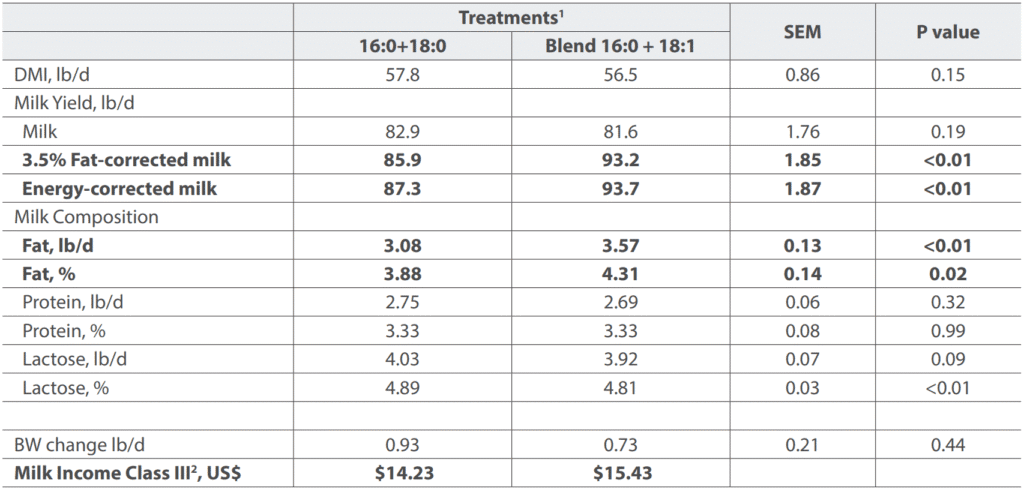
1Treatments were diets supplemented at 1.5% DM with a 16.0+18.0 supplement (50% 18:0; 28% 16:0, 8% 18:1) or a blend of 16:0+ 18:1 (80% C16:0, 5% 18:0, 10% 18:1).
Main effect of treatment is reported.
2Calculated based on component prices for May, 2023.