
Science based. Research driven.®
Keeping the informed and scientific beat on amino acid and fatty acid nutrition for dairy cattle.
Assessing the value of protein feedstuffs for lactating dairy cows
The autumn season is approaching and so is new crop corn and soybeans. Prices of feeds are often at their yearly low and dairymen are looking to contract material. Determining the value of different feeds is especially important this time of year.
Historically, we have valued high-protein feeds based on their crude protein content. Blood meal has twice the protein as soybean meal, so logically, it should be twice as expensive as soybean meal. However, we all know this approach is flawed. The value of a feed should really be based on metabolizable amino acid supply—remember, not all amino acids are created equal for a dairy cow. Some have a much larger impact on milk protein production—Met, Lys and His, whereas other, like the non-essential amino acidss, have no impact or only a small impact on milk protein production. So the question remains: how should we account for this when determining the value of different feedstuffs?
Until recently, there was no great way to put a numeric value to the amino acid profile of feed. With the release of the new dairy NASEM (2021), we now have a method to determine the relative value of the amino acid profile of a given feedstuff. In NASEM, there is an equation to predict milk protein yield that includes amino acid supply along with other nutrients.
Based on these new equations, another question emerges: how do we determine the quality of a given protein source? For years, human nutritionists have used something called the digestible individual amino acid score to assess the quality of protein from different foods. With this method, we know that meat and milk supply a better amino acid profile for humans than vegetable protein such as soy, peas, etc. Based on the same premise as the human nutrition approach, we can apply the equations generated by NASEM (2021) to assess the protein quality of different feedstuffs.
The values generated from this approach are indexed relative to a baseline feedstuff. We have termed this value the AA Index. In the example reported in Table 1, soybean meal is used as the reference protein as this is generally the most commonly fed protein source for lactating dairy cows. Keep in mind this approach only looks at the metabolizable amino acid supply from a given feedstuff. Thus, it does not account for positive or negative value due to other nutrients (energy, rumen-degradable protein, fatty acids, etc.).
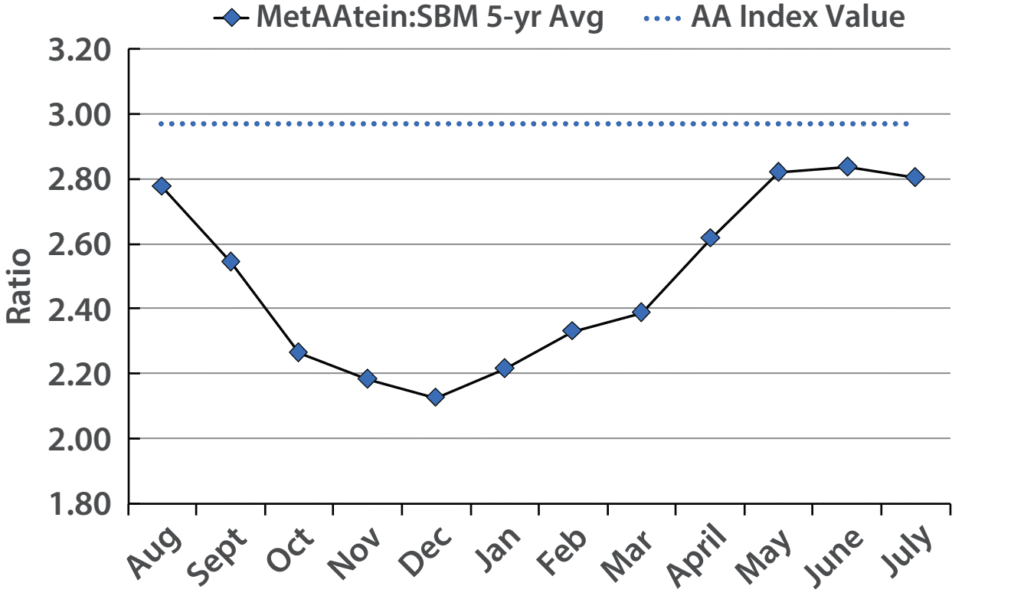
Blood meal is known for being a high-quality amino acid source, which is highlighted by an AA Index of 242% of soybean meal. Interestingly, the average price of blood meal relative to soybean meal over the past 5-years has been very close to its AA Index (235% on cash market basis). Price of blood meal can be quite variable with prices being the lowest in the fall and winter months and highest in the spring and summer months. Our product, MetAAtein,
follows the same pricing trends as blood meal (Figure 1). However, it is a more digestible and consistent source of amino acids and has an AA Index of 297% of soybean meal.
Table 1. Amino acid (AA) index and shadow price for various high-protein feedstuffs.
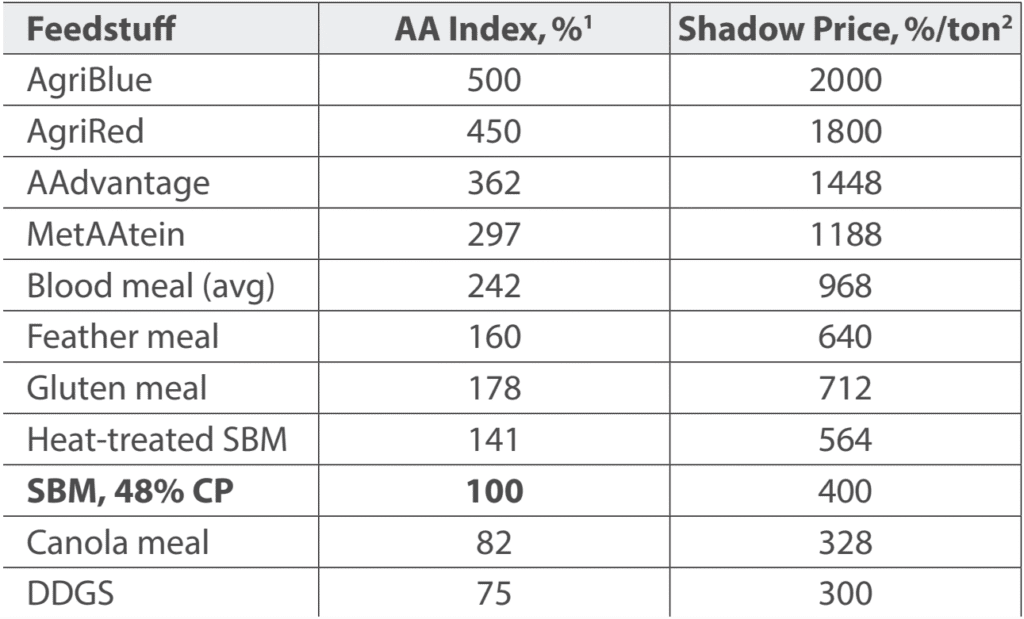
1Calculated relative to 48% CP soybean meal at an equal feeding rate, using amino acid supply prediction from the Cornell Net Carbohydrate and Protein System (v6.55).
2Calculated relative to 48% crude protein soybean meal based on AA index.
Figure 1. 5-year average price of MetAAtein relative to soybean meal (Chicago Mercantile Exchange nearby futures) and the AA Index value for MetAAtein.