
Science based. Research driven.®
Keeping the informed and scientific beat on amino acid and fatty acid nutrition for dairy cattle.
Supplementing rumen-protected methionine to lactating dairy cows challenged with subclinical mastitis improves lactation performance and alleviates inflammation
Mastitis, a prevalent production disease in dairy cattle, results in significant losses due to decreased milk production, increased veterinary costs, and heightened antibiotic use. Subclinical mastitis is particularly problematic because it lacks visible symptoms yet leads to elevated somatic cell counts, negative animal health effects, and reduced milk yield and quality. A recent study was conducted at South Dakota State University to investigate the impacts of feeding rumen-protected methionine on lactation performance, inflammation and immune response, and liver glutathione of lactating dairy cows during a subclinical mastitis challenge. Understanding the role of rumen-protected methionine supplementation on the immune system may help build the foundational work for dietary mitigation strategies aimed at alleviating production and economic losses due to disease.
Thirty-two mid-lactation Holstein cows were used in a randomized complete block design and assigned to one of two diets. Cows were fed experimental treatments from -21 to 7 d relative to the subclinical mastitis challenge consisting of either a basal diet (CON) or a basal diet plus a pH-sensitive polymer coated rumen-protected methionine at a rate of 0.09% DM (RPM). After 21 d on dietary treatments, the mammary gland’s rear right quarter of all cows was infused with 100,000 cfu of Streptococcus uberis strain O140J in 5 mL of inoculum.
Table 1 presents lactation performance parameters during the challenge, while Table 2 shows the blood and liver biomarkers from 0 to 72 h relative to the subclinical mastitis challenge and Table 3 shows the flow cytometry data on ratio of phosphorylated to total protein AKT and S6RP in mammary gland cells.
Table 1. . Total ether extract, acid-hydrolysis ether extract, and total fatty acids of different feedstuffs (mean ± SD).
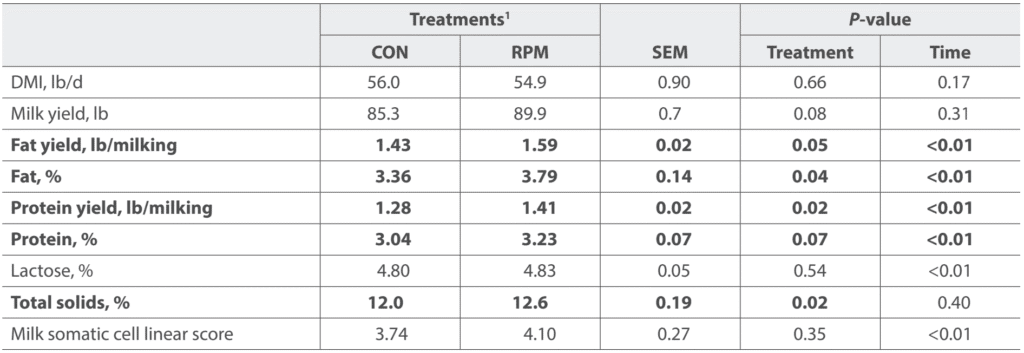
1 CON = basal diet plus 100g of ground corn, RPM = basal diet plus rumen-protected methionine at a rate of 0.09%, and 100g of ground corn.
Table 2. Blood and liver biomarkers from 0 to 72 h relative to a subclinical mastitis challenge.
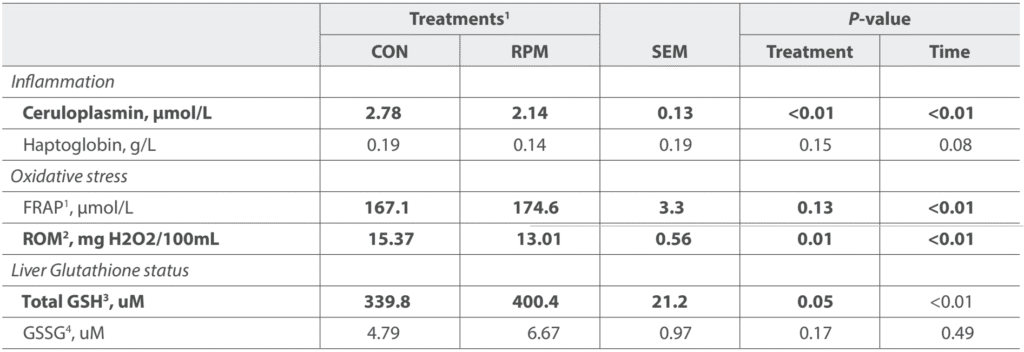
1FRAP = ferric-reducing antioxidant power.
2ROM = reactive oxygen metabolites.
3GSH = glutathione.
4GSSG = oxidized glutathione.
Table 3. Flow cytometry data on ratio of phosphorylated (p) to total protein AKT (pAKT:AKT) and S6RP (pS6RP:S6RP) in mammary gland cells.
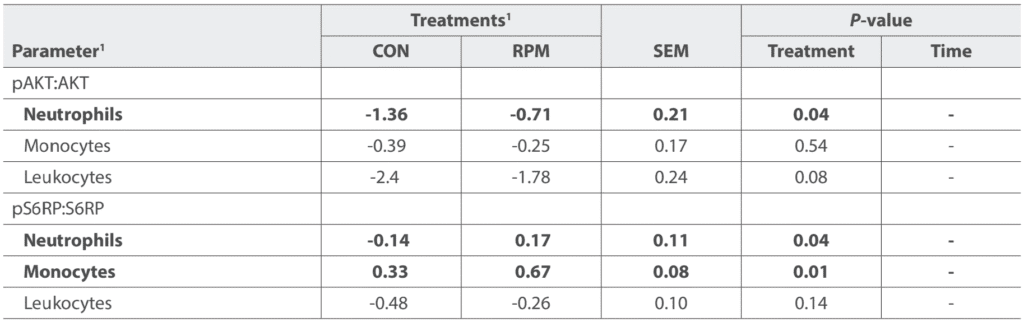
1CON = basal diet plus 100g of ground corn, RPM = basal diet plus rumen-protected methionine at a rate of 0.09%, and 100g of ground corn.