
Science based. Research driven.®
Keeping the informed and scientific beat on amino acid and fatty acid nutrition for dairy cattle.
Raw vs Roasted Soybeans – Feeding roasted high oleic soybeans to high producing cows
Soybeans are a common oilseed used in dairy rations as a source of both protein and energy. Recently high oleic soybeans (HOSB) have been developed due to interest from the human food industry to have an increase in oleic acid compared to linoleic acid. This shift in fatty acid profile makes HOSB of interest for dairy producers since oleic acid lowers the risk of milk fat depression and offers a potential tool for increasing milk fat.
Even at very high levels (~24% diet DM), HOSB are shown to increase milk and milk fat yields. As they have grown in popularity, more questions have been raised about implementation strategies in dairy diets, especially relating to how HOSB work as a protein source. A recent study from Michigan State University investigated the effects of feeding raw or roasted HOSB
to high-producing cows.
Thirty-six multiparous Holstein cows (45.6 kg ± 6.22 kg/d of milk yield) were used in a 4 x 2 truncated Latin square design with 35 d periods to enable evaluation of longer-term effects of feeding HOSB. Cows were fed either a control diet with no HOSB (CON); 16% DM roasted and ground HOSB (RST); 16% raw and ground HOSB (RAW-D); or 16% raw and ground HOSB bypass protein (RAW-U). The CON treatment represented a low-fat diet, while all HOSB treatments were balanced for fatty acids. When comparing roasted versus raw HOSB, the primary difference between treatments was in the protein fractions. The RUP fraction in the roasted soybean diet was the highest (45.2% of CP) due to the heat treatment, followed by CON and RAW-D treatments (35.4% and 34.6% respectively). Finally, RAW-U had added by-pass protein which made it higher than RAW-D (39.9%).
Figure 1 highlights the difference in the fatty acid profile between conventional soybeans and HOSB. Table 1 presents overall intake and lactation performance data while Figure 2 presents the weekly milk and milk fat yields.
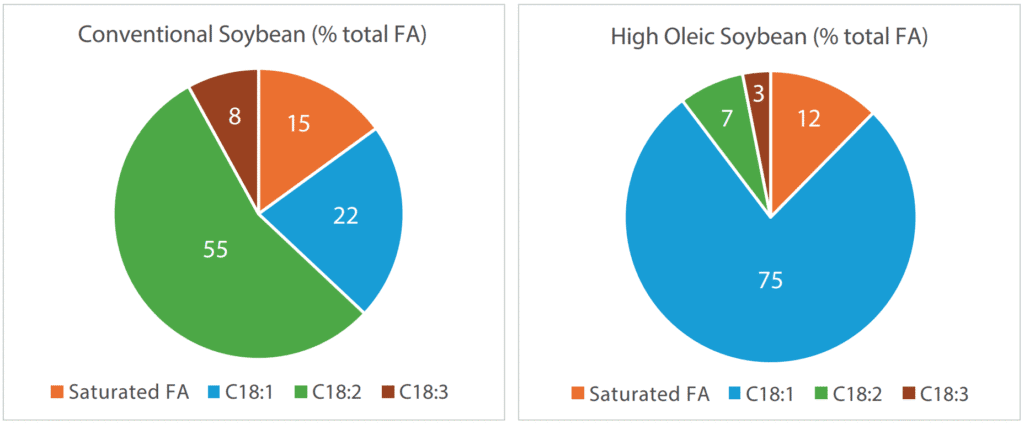
Figure 1. Comparison of the fatty acid profile of conventional and high oleic soybeans.
Table 2. Feed intake and lactation performance parameters from multiparous cows fed raw or roasted high oleic soybeans.
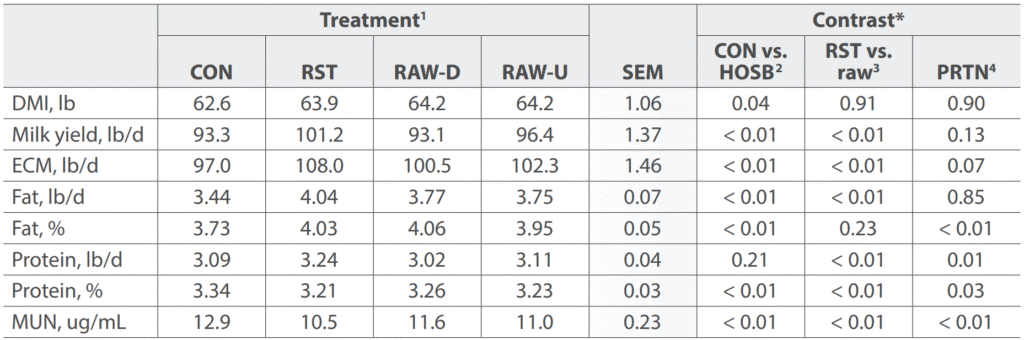
1CON = control diet with no HOSB supplementation; RST = 16% DM roasted and ground HOSB; RAW-D = 16% raw and ground HOSB; RAW-U = 16% raw and ground HOSB + bypass protein
2CON vs. HOSB = CON vs RST + RAW-D + RAW-U
3RST vs. raw = RST vs RAW-D + RAW-U
4PRTN = RAW-D + RAW-U
*Significance was declared at P-value ≤ 0.05; tendency was declared at 0.10 ≥ P-value > 0.05.