
Science based. Research driven.®
Keeping the informed and scientific beat on amino acid and fatty acid nutrition for dairy cattle.
Optimizing the Response of Supplemental Lysine in Lactating Dairy Cows
Lysine is often the first limiting essential amino acid in metabolizable protein (MP) for
lactating dairy cows, particularly in corn- and soybean-based diets. However, production
responses to rumen-protected lysine (RPL) have been inconsistent across research studies
over the years, making it difficult to determine when supplementation is both biologically
effective and economically justifiable. To address this variability, Arshad et al. (2024)
conducted a meta-analysis to better quantify the effects of lysine supply on milk yield,
component production, and feed efficiency, while also evaluating its interaction
with methionine.
The meta-analysis integrated data from 13 experiments, representing 40 treatment means
and 594 lactating cows. All experiments had a non-supplemental control (n = 17 treatment
means), or a group supplemented with RPL (n = 23 treatment means). Production data
were standardized using NASEM (2021) modeling to estimate MP and amino acids supply,
including metabolizable lysine as a percentage of MP (LYSMP) and metabolizable methionine
as a percentage of MP (METMP). Statical models were then used to evaluate the effects of
increasing lysine supply, duration of supplementation, and stage of lactation, as well as
interactions between lysine and methionine on production responses and blood amino acid
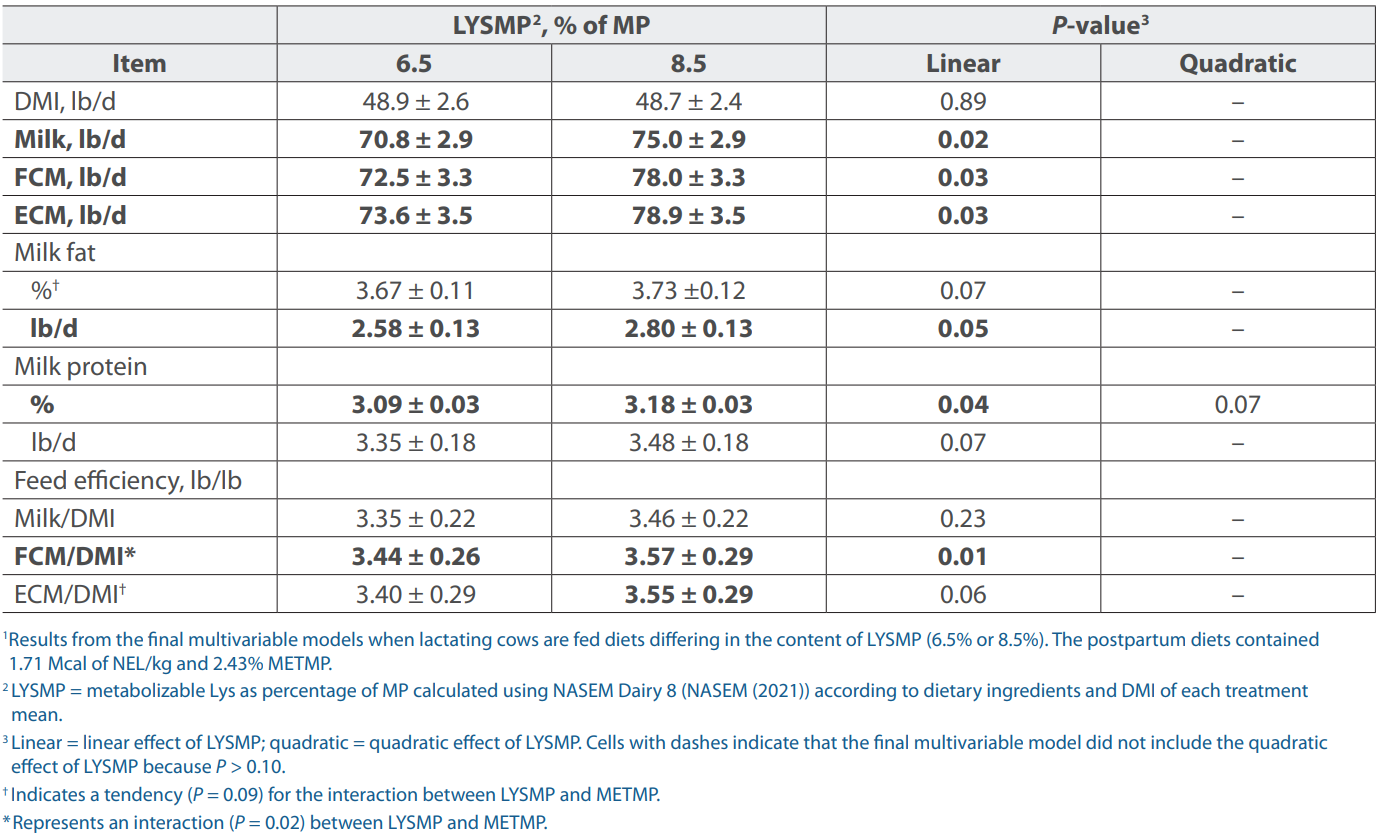
concentrations. Table 1 presents the estimated LSM and respective SEM for performance
when lactating cows are fed postpartum diets differing in metabolizable lysine as percentage
of MP (6.5 or 8.5%).
Table 1. Estimated LSM and respective SEM for performance when lactating cows are fed postpartum diets differing in metabolizable Lys as percentage of MP (6.5 or 8.5%)1
SUMMARY:
Citation: Arshad, U., F. Peñagaricano, and H. M. White. 2024. Effects of feeding rumen-protected lysine during the postpartum period on performance and amino acid profile in dairy cows: A meta-analysis. J. Dairy Sci. 107:4537–4557. https://doi. org/10.3168/jds.2023-24131