
Science based. Research driven.®
Keeping the informed and scientific beat on amino acid and fatty acid nutrition for dairy cattle.
Maintaining Adequate Metabolizable Protein with High-Quality Blood Meal Supports Milk and Protein Yield
As dairy nutritionists work to improve nitrogen efficiency and refine amino acid balancing, rumen-protected amino acids can provide targeted sources of metabolizable lysine and methionine. However, replacing a high-quality rumen undegradable protein source with individual protected amino acids may reduce total metabolizable protein (MP) and the broader supply of essential amino acids. Arshad et al. (2026) evaluated whether rumen-protected lysine (RPL) could replace lysine supplied by porcine blood meal (PBM; ProvAAl2 AAdvantage®) while metabolizable methionine was maintained across diets.
The 12-week study included sixty-four high-producing, mid-lactation Holstein cows assigned to one of four diets. The control diet used PBM as the primary source of metabolizable lysine. The remaining diets replaced 33%, 66%, or 100% of the lysine from PBM with RPL. While lysine and methionine supply were maintained, progressively replacing blood meal reduced total MP supply and lowered the estimated delivery of several other metabolizable essential amino acids, with the greatest reductions observed for histidine, leucine, and valine (Table 1). The three replacement diets supplied 27, 70, and 114 g/d less MP than the estimated requirement at formulation.
Increasing replacement of PBM with RPL linearly reduced milk, true protein, and lactose yields (Table
2). Complete replacement lowered milk yield by 8.2 lb/d and true protein yield by 0.22 lb/d compared with the PBM diet. Dry matter intake and energy corrected milk also tended to decline, while feed efficiency and nitrogen use efficiency remained unchanged. Nitrogen intake, milk nitrogen, urinary nitrogen, milk urea nitrogen, and urinary urea nitrogen decreased as PBM was removed. These reductions reflected lower protein intake and milk output rather than an improvement in the proportion of dietary nitrogen captured in milk.
Cows maintained body weight, body condition score, net energy balance, and milk fat yield across treatments. Methane production, yield, and intensity were also unaffected. However, nutrient partitioning shifted as MP supply declined: carbohydrate oxidation increased, fat oxidation and metabolic heat production decreased, and milk production decreased. Collectively, the results indicate that balancing lysine and methionine alone did not compensate for inadequate total MP or for the broader amino acid profile supplied by PBM.
Table 1. Estimated supply of metabolizable EAA according to diets fed to postpartum mid-lactation Holstein cows based on actual DMI1
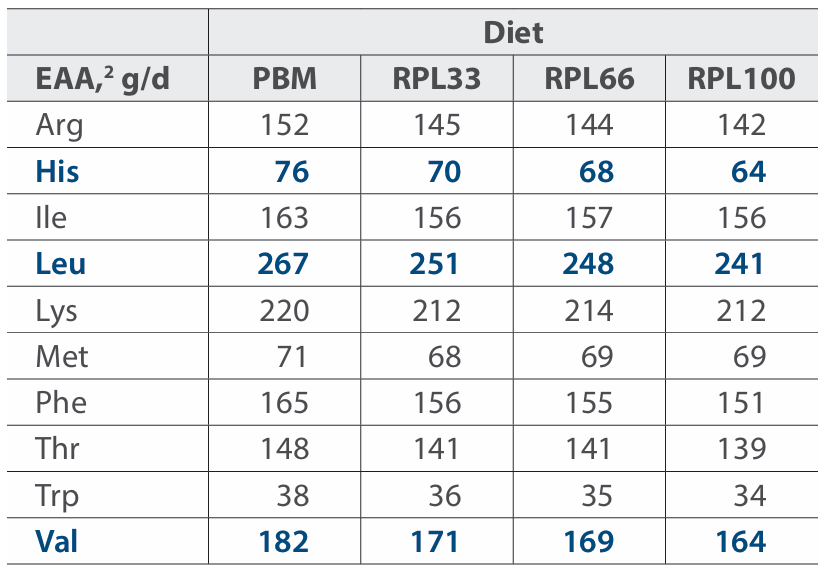
1 Mid-lactation Holstein cows were fed a postpartum diet containing PBM or replacing 33% of metabolizable Lys of PBM with RPL (RPL33), replacing 66% of metabolizable Lys of PBM with RPL (RPL66), or replacing 100% of metabolizable Lys of PBM with RPL (RPL100). All treatments were balanced for concentrations of metabolizable Met in the diet.
2 The estimated supply of EAA, based on NASEM (2021), was adjusted according to the actual mean DMI recorded throughout the 12-wk treatment period.
Table 2. Effect of replacing metabolizable Lys from porcine blood meal (PBM) with increasing dose of rumen protected lysine (RPL) on productive performance in mid-lactating Holstein cows.
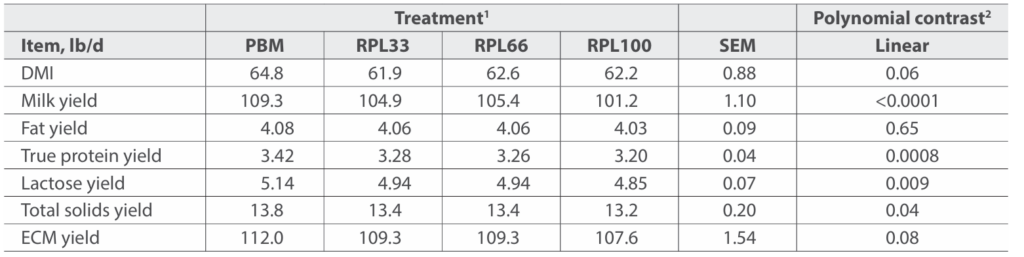
1 Mid-lactation Holstein cows were fed a postpartum diet containing PBM or replacing 33% of metabolizable Lys of PBM with RPL (RPL33), replacing 66% of metabolizable Lys of PBM with RPL (RPL66), or replacing 100% of metabolizable Lys of PBM with RPL (RPL100). All treatments were balanced for concentrations of metabolizable Met in the diet.
2 Linear = linear effect of replacing RBM with RPL.
SUMMARY:
Citation: Arshad, U., S. J. Johnson, R. Fukumori, A. J. Bowers, S. J. Kendall, F. Sun, V. M. R. Malacco, I. Brown-Crowder, and H. M. White. 2026. Effects of replacing porcine blood meal with rumen-protected lysine, while maintaining metabolizable methionine supply, on performance, N use efficiency, and nutrient partitioning in dairy cows. J. Dairy Sci. 109:8069-8085. https://doi.org/10.3168/jds.2025-27475