

Science based. Research driven.®
Keeping the informed and scientific beat on amino acid and fatty acid nutrition for dairy cattle.
Supply of branch-chain volatile fatty acids improve fiber digestibility and microbial growth but has a modest influence on production responses
Branched-chain volatile fatty acids (BCVFA), which are formed by the degradation of
branched-chain amino acids, are required growth-promoting factors for some fiberdegrading bacteria. Previous research has indicated that several rumen bacteria require
BCVFA for growth. Additionally, BCVFA are primers for branched-chain lipids used in bacterial
membrane structure and essential for optimal growth. A recent series of studies conducted at
Ohio State University were designed to evaluate whether supplying BCVFA would influence
microbial growth and fiber digestibility when diets varied in forage and poly-unsaturated
fatty acid (PUFA) levels in an in vitro system. Also, they evaluated the effects of feeding BCVFA
on the production responses of mid-lactation Jersey cows.
In experiment 1, 8-dual flow continuous culture vessels were randomly assigned to treatment
with either BCVFA supplementation (2.15 mmol/d isobutyrate, 2.15 mmol/d isovalerate, and
2.15 mmol/d 2-methylbutyrate) or no supplemental BCVFA, high forage: concentrate diet
(67:33) or low forage: concentrate diet (33:67), and either supplemental corn oil (additional
3% of DM) or no additional fat supplement. In experiment 2, 60 Jersey cows were used in
a block design receiving diets for 8-weeks. Cows were randomly assigned to 4 treatments:
CON (treatment without any isoacids), 2-methylbutyrate (12.3 mmol/kg DM of MB), MB +
isobutyrate (MB+IB, 7.7 and 12.6 mmol/kg DM, respectively), or isoacids [(ISO) 6.2, 7.3, 4.2,
and 5.1 mmol/kg DM, respectively, of MB, IB, isovalerate, and valerate).
Table 1. Nutrient degradability, nitrogen flow rates, and bacterial efficiency in continuous cultures administered with either high or low forage diets that varied in corn oil and BCVFA supplementation.

Only the main effect of BCVFA is reported in the table above.
Table 2. Lactation performance of Jersey cows fed different combinations of BCVFA.
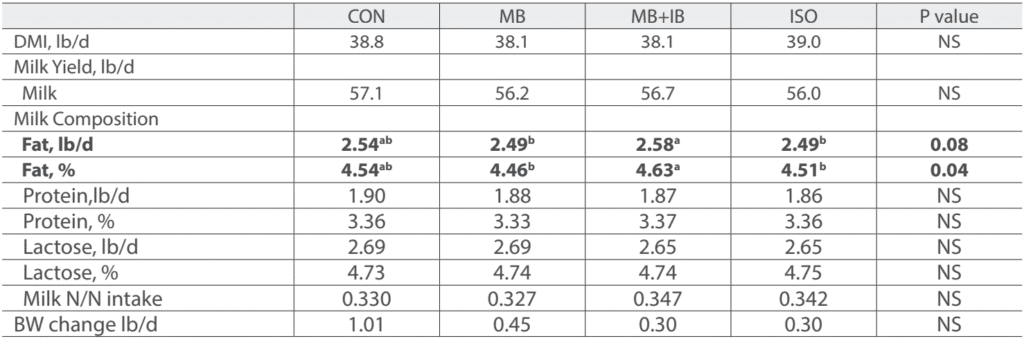
Treatments: control (CON), no supplement; 2-methylbutyrate (MB), MB + isobutyrate (MB + IB), and MB + IB + isovalerate + valerate (ISO).
Means in the same row with different letters tended to differ (P ≤ 0.10).