Science based. Research driven.®
Keeping the informed and scientific beat on amino acid and fatty acid nutrition for dairy cattle.
Metabolizable Protein Supply improves early lactation performance in transition cows
During the transition period, dairy cows experience a protein deficit. The demand for amino
acids to support colostrum and milk production, immune function, and glucose synthesis
often exceeds the supply because of a reduction in feed intake. This imbalance is worsened
by a negative energy balance, which leads to tissue breakdown, diverting amino acids away
from protein synthesis and toward energy production.
While increasing metabolizable protein (MP) after calving has been shown to improve milk
production, results from prepartum MP supplementation have been inconsistent. Many
past studies did not control for methionine and lysine, leaving uncertainty about whether
responses were due to total MP or specific amino acids. A recent study was conducted at
Cornell University to evaluate how increasing MP supply while controlling the effects of
methionine and lysine, before calving, after calving, or during both periods affects early
lactation performance in transition cows.
Ninety-six multiparous Holstein cows were assigned to one of four treatment groups at 28 d
before expected calving. Prepartum diets were formulated to contain either a control (CON;
85 g of MP/kg DM) or high (HI; 113 g of MP/kg DM) level of estimated MP. From calving to
21 DIM, diets were formulated to contain either a CON (104 g of MP/kg DM) or HI (131 g of
MP/kg DM) level of estimated MP. To control the potential confounding effect of methionine
and lysine supply, diets were formulated to supply an equal amount at 1.24 and 3.84 g/Mcal
of ME in both prepartum diets and 1.15 and 3.16 g/Mcal of ME in both postpartum diets,
respectively. ProvAAl Lysine® was used in the formulation to adjust and achieve the desired
MP levels across treatments while maintaining consistent lysine supply. The combination
of a pre- and postpartum diet resulted in 4 treatment groups: (1) CON-CON (CC; n = 23), (2)
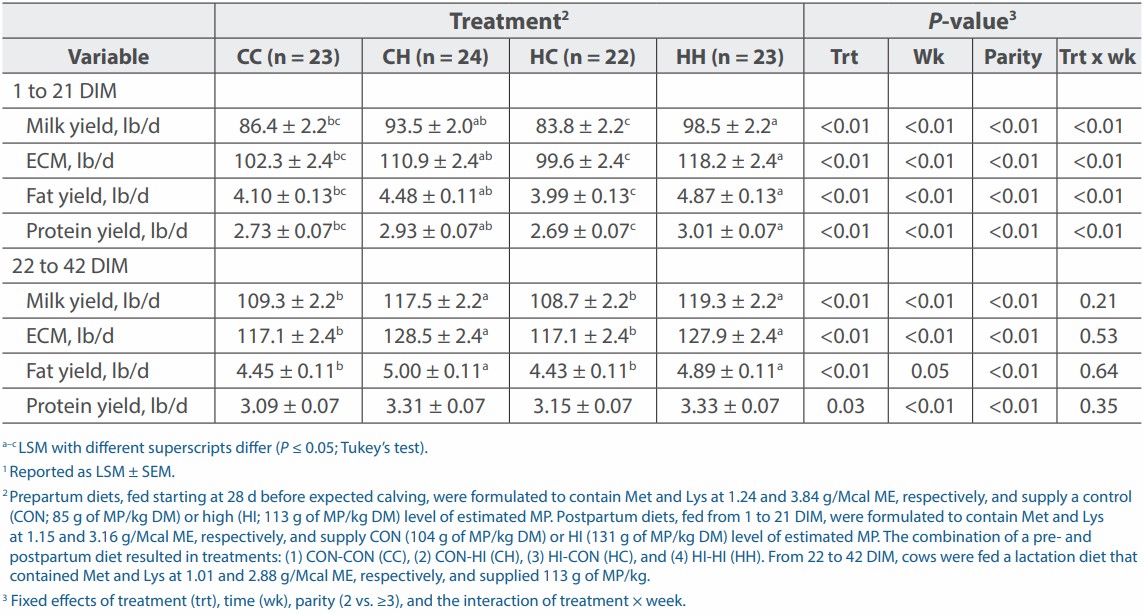
CON-HI (CH; n = 24), (3) HI-CON (HC; n = 22), and (4) HI-HI (HH; n = 23). A common lactation diet (113 g of MP/kg DM) was fed from 22 DIM to the end of the observation period at 42 DIM. Table 1 shows the effects of increasing MP supply in the prepartum, postpartum, or both diets on milk yield and composition.
Table 1. Effect of increasing MP supply in the prepartum, postpartum, or both diets on milk yield and composition1